- Shocki News
- AI content
- Creator marketing
How LinkedIn detects AI slop: filtering out generic, AI-churned posts
A look at how LinkedIn filters out generic or repetitive posts with no new insight, known as AI slop. We cover the report button, how the AI is trained, human review, 94% precision, and the 40% drop in views.
Dongle Media Lab6 min read
Adapted from ShortShock's “Shocki News” short-form video. Watch it on ShortShock's Instagram (@shortshock.offical).
Key takeaways
LinkedIn treats generic or repetitive posts with no new insight as AI slop, and it filters them out using a mix of user reports, AI training, and human review. Views of AI slop on LinkedIn have dropped 40%. If you're a brand manager or creator who leaves captions or posts to AI, add a line of your own experience or thinking before you publish.
Views of generic, AI-churned posts on LinkedIn have dropped 40%. Tim Junka, LinkedIn's VP of Engineering, explained in a post of his own how the company filters out these posts, and Social Media Today reported on it. If you leave captions or posts to AI, it's worth knowing the criteria and methods platforms use to filter content.

What does LinkedIn mean by AI slop?

AI slop is LinkedIn's name for generic or repetitive posts with no new insight. The test is whether a post offers new insight. Posts that repeat the obvious are the target.
According to Social Media Today, Tim Junka, LinkedIn's VP of Engineering, wrote a post of his own laying out how the company catches these posts. It covers how LinkedIn approaches detection and how it trains the AI used for detection. The methods fall into three broad groups: user reports, AI training, and human review.
How is the AI slop report button used?
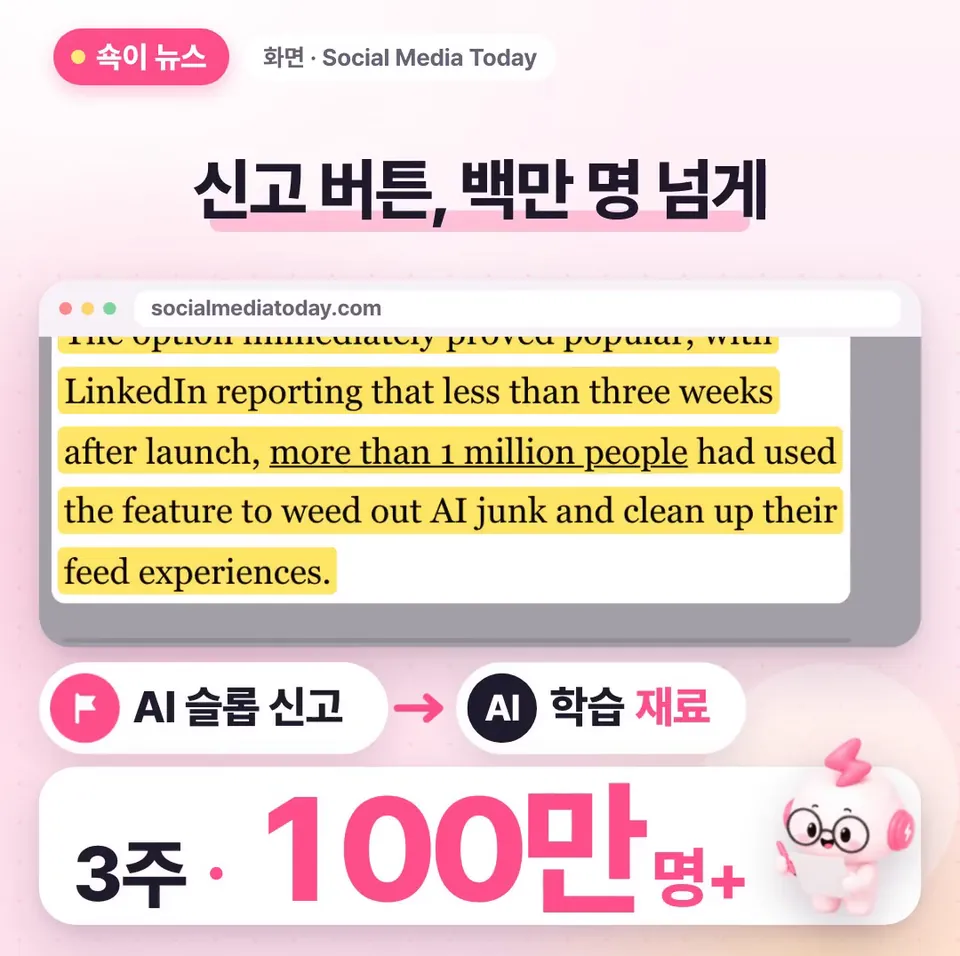
The AI slop reports users submit are used to teach the detection AI. The report button sits in the feed, so you can tap it as soon as you see a post.
More than a million people tapped this button in under 3 weeks. All of those reports become training material for the AI. In effect, users' judgment is the first step in building the detection AI.
How does the detection AI learn?

A large AI creates the training material, and a small AI learns from it. The large AI's job is to keep up with newly emerging patterns and turn them into training material.
Posts that are hard to call go to human reviewers. To sum up, there are three steps: the large AI keeps up with new patterns and creates material, the small AI learns from that material, and people look at the borderline posts.
How widely and how accurately does it catch slop?

The AI trained this way checks every single post that spreads beyond your own network. In other words, any post that reaches more people than those you know goes through a check.
The results are fairly accurate, too. Of the posts the AI flagged as slop, 94% actually were slop. This ratio is called detection precision. And views of AI slop on LinkedIn have dropped 40%.
What should you do if you drafted with AI?

Before you post, add a line of your own experience or thinking. That's because what LinkedIn is going after is generic posts with no insight.
If you're a brand manager or creator who leaves captions or posts to AI, start by building the habit of not publishing the draft as is. Add at least one line that only that post has, such as something you went through or what you think.
Key takeaways
- LinkedIn treats generic or repetitive posts with no new insight as AI slop and filters them out.
- AI slop reports submitted from the feed are used as material to train the detection AI.
- Every post that spreads beyond your network gets checked, and detection precision is 94%.
- If you drafted with AI, add a line of your own experience or thinking before you post.
Frequently asked questions
- How does LinkedIn filter out AI slop?
- It uses a mix of user reports, AI training, and human review. Reports from the feed become AI training material. A small AI learns from training material created by a large AI, and human reviewers look at posts that are hard to call.
- How accurate is AI slop detection?
- Of the posts the AI flagged as slop, 94% actually were slop. Views of AI slop on LinkedIn have dropped 40%.
- How should I polish AI-written captions or posts before publishing?
- What LinkedIn is going after is generic posts with no insight. If you drafted with AI, add a line of your own experience or thinking before you post.